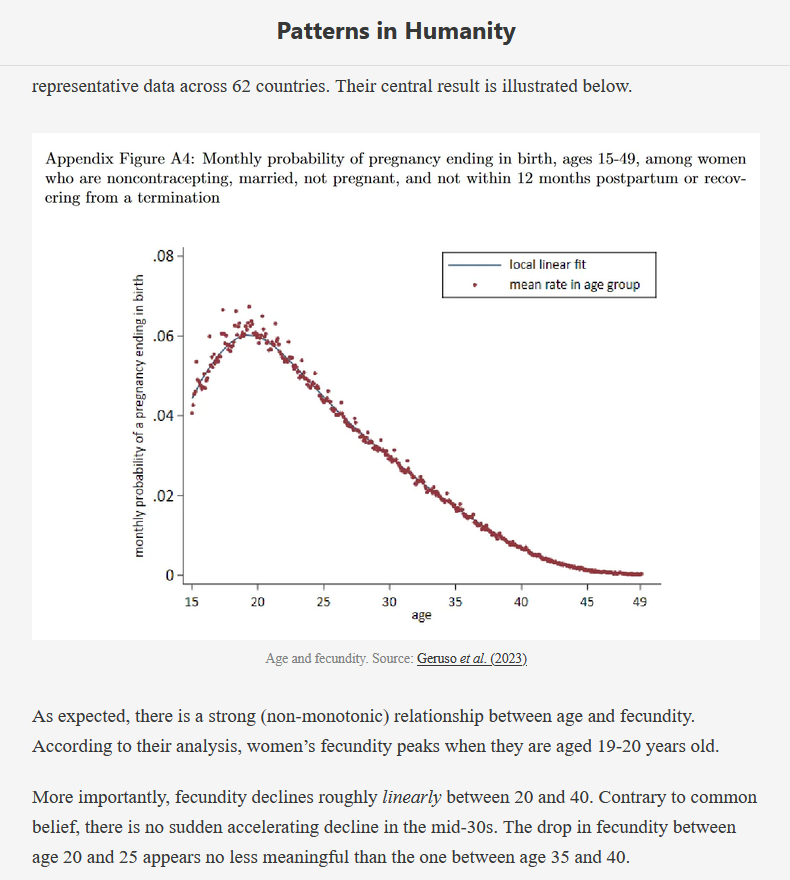
Summary: According to Geruso et al. (2023), female fertility peaks at around age 19-20. After about age 20, fertility declines in a more or less linear fashion until age 40, rather than rapidly in the middle of the third decade of life. The commonly cited "accelerated decline after age 35" curve is largely a statistical artifact resulting from biased methods of estimating fertility/reproductive rates across age groups. Variations in who is trying to get pregnant at different ages can make it so that data on fertility rates by age do not reflect true fertility by age. Including months in which women are pregnant or postpartum in the denominator causes bias in fertility estimates by age group, and this bias changes with age. The re-estimated fertility curve by age by Geruso et al. is based on data on about 2.8 million women from nationally representative data from 62 countries. The decline in fertility at ages 20-25 is about as significant as the decline at ages 35-40, contradicting the notion that "age 20 doesn't matter." In Denmark, the incidence of trisomies 21, 18 and 13 rises sharply with maternal age, and Down syndrome is particularly common after age 40 (Frederiksen et al., 2024). Cross-sectional "U-shaped" associations between maternal age and low birth weight/prematurity link the actual effects of aging to selection/interference factors. Comparative sibling studies show that increased risk of low birth weight for advanced maternal age persists in families, consistent with a causal effect of aging. The same sibling studies show that the apparent risk for very young maternal age largely disappears in families, suggesting confounding factors/selection rather than age itself. Sibling analyses indicate that cross-sectional studies slightly underestimate the harms of advanced maternal age, probably because mothers at later ages are otherwise healthier, masking some of the harms of aging. The father's age also reduces fertility, but the decline is slower and smaller than the impact of the mother's age. When women use donor egg cells, a woman's age has little effect on IVF success, suggesting that it is the age of the egg (rather than the "age of the uterus") that causes most of the age-related decline in fertility. The success of assisted reproduction depends mainly on the age of the oocytes and the number of oocytes retrieved, and poor results are largely attributed to starting treatment too late rather than to the failure of the technology.
Comments
Be the first to comment!