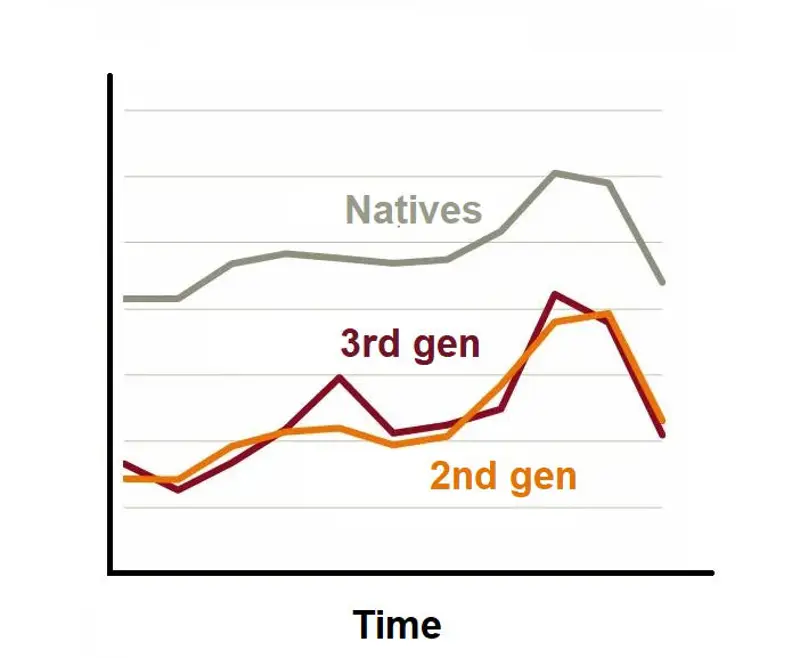
Summary: Differences in human capital between immigrants and ethnic groups do not disappear quickly and remain strongly related to country of origin. Second-generation test scores are more similar to those of parents from the country of origin than to the average of the destination country. According to international PISA/TIMSS/PIRLS data, the competency gap between native-born and immigrants narrows on average by only about 1 IQ point between the first and second generations. Even in the same schools and after accounting for socioeconomic factors, the origin of parents from higher-performing countries predicts higher student performance, suggesting strong pre-migration or hereditary differences. Large deviations from the norm, such as for Indians, are explained by strong positive selection of immigrants rather than rapid assimilation. Denmark and the Netherlands show large differences in human capital due to ancestry that persist until at least the third generation, with no further convergence after the second generation. Historical data on the education of people of Mexican descent in the United States do not confirm assimilation in educational attainment, even across multiple generations. Economic disparities between immigrant origin groups persist across generations, with some groups (e.g., descendants of Chinese in the Netherlands) outperforming natives, and others (e.g., people from the Middle East, Morocco and Turkey) remaining financially disadvantaged over the long term. Persistent differences in human capital are recognized as a major factor behind persistent differences in income and mobility between groups (including differences in mobility between blacks and whites in the United States). Long-lasting wealth differences can persist for more than a century, even in the case of mixed marriages, as in the case of the wealth gap between the British and the Irish in England. The socioeconomic advantage of Copts in Egypt is attributed to centuries of selective conversion, which eliminated the poorer Copts, leaving a remaining higher-status portion that continues to outperform Muslims. Differences in crime rates by origin show little systematic improvement between the first and second generations, and sometimes even worsen. In Denmark, age-adjusted crime rates by origin correlate at about 0.90 between immigrants and their descendants, meaning that the rankings of the groups hardly change between generations. Differences in homicide and homicide arrest rates between blacks and whites in the United States have remained large since the early 20th century and show no significant long-term convergence. Cultural values change slowly, if at all, over two generations, and historical European immigration continues to predict contemporary policy preferences in the United States consistent with the values of the country of origin. Some family formation behaviors show extreme persistence, with high rates of marriage between cousins persisting in the Pakistani and Turkish diasporas until the third generation.
Comments
Be the first to comment!