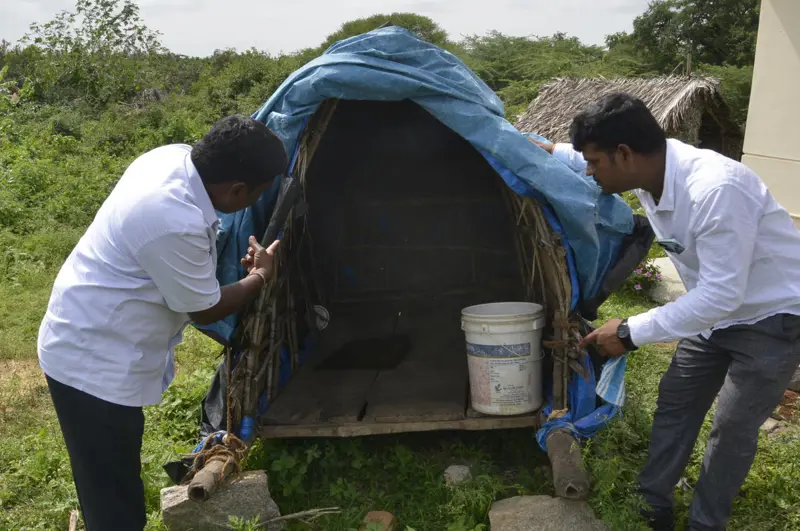
We are talking about the region with the fourth highest GDP per capita in India. Karnatarka according to Wikipedia: "Karnataka is a leader in India's IT sector, and its capital, Bengaluru, is called India's Silicon Valley.", "Karnataka, particularly the coastal districts of Dakshina Kannada and Udupi, is sometimes called the 'cradle of banking' in India.", "Karnataka has one of the largest concentrations of higher education, including medical and engineering colleges.", "Bengaluru, [....] Mangalore, [...] educate professionals for the IT industry.", "is home to Sri Sathya Sai Baba University and Medical College and a branch of the Visvesvaraya Institute of Advanced Technology.", "Special Economic Zones for Aerospace Education, [...]. Many prestigious educational and research institutions are located there." Let's turn to excerpts from the source article: "In the village of Mallenahalli, a mother and her newborn were locked in a hut in front of their home in the pouring rain, leading to the death of the child. Despite the outcry against the practice, many members of the Kadu Golla community continue to practice it, according to reporters from The Hindu, who arrived in the area, less than 100 kilometers from Bengaluru, a city known for its technological innovation and global thought." Postpartum and menstruating women are kept away from their homes in makeshift or semi-permanent structures for a set number of days. They say this practice has been practiced for centuries; it is "normal." [...] "It's an ancestral tradition. If we don't do it, we make our god angry, and we don't want that," - Nagamma says. But they also proudly say that the practice is no longer as strict as it once was. Carefully folding a beetle leaf and putting it in her mouth, Neelamma says thoughtfully, "In the past, we didn't take any medicine during pregnancy or after giving birth. We had five or six children then. Times have changed. When my sister's daughter was pregnant, we told her not to take any medication, but my daughter, who is an ASHA employee, intervened and said she had to take medication," she says with a note of pride in her voice. [...] over the past 50 years, the community has focused on raising sheep and settling in one place, but the practice of building separate buildings for mothers and menstruating women has remained. "Although other communities have influenced them and changed some of their customs, the belief [about women's impurity during their periods and after childbirth] has remained." - she said."
Comments
Be the first to comment!