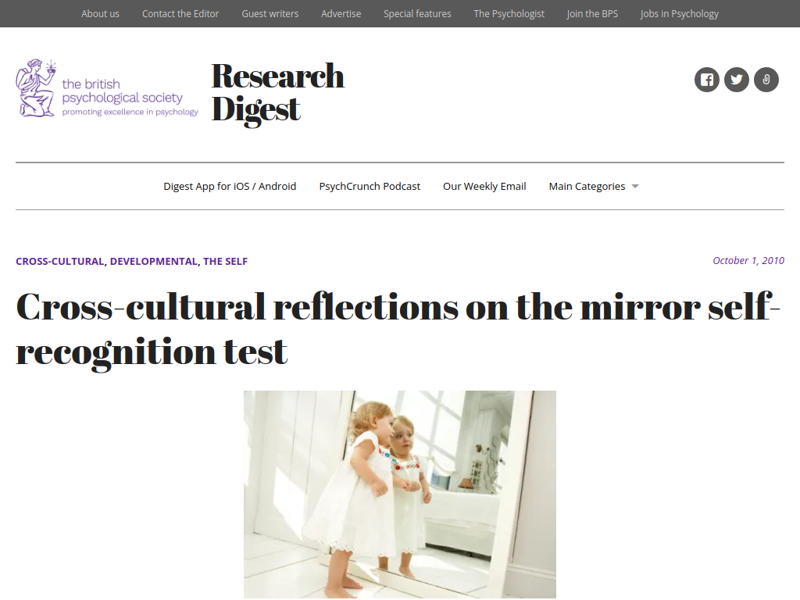
Young children's performance on the "recognize yourself in a mirror" test varies widely across cultures, a new study has shown. The test involves discreetly making a mark on a child's forehead and then observing his or her reaction to seeing the reflection in the mirror. The child's attempts to touch or remove the mark are perceived as a sign that he recognizes himself in the mirror. Research in the West suggests that about half of 18-month-olds pass the test, with the percentage rising to 70% at 24 months. Chimpanzees, orangutans, dolphins and elephants have also been shown to pass the test, and there is recent debate over whether monkeys can as well. Tanya Broesch and her colleagues began by conducting a simplified version of the mirror self-recognition test in Kenya, where they subjected 82 children between the ages of 18 and 72 months to the test. This version of the test relied on a small yellow sticky note instead of a red blotter, and the children were not given standard verbal questions such as "who is that in the mirror?". Amazingly, only two children "passed" the test by touching or removing the sticky note. The other eighty children "froze" when they saw their reflection - that is, they stared but did not respond to the card. Broesch and her team then conducted the test in Fiji, St. Lucia, Grenada, Peru, Canada and the US, where they tested 133 children between 36 and 55 months of age. The results of the North American children were consistent with previous studies: 88% of children in the US and 77% in Canada passed the test. Pass rates in Saint Lucia (58%), Peru (52%) and Grenada (51%) were much lower. In Fiji, none of the children passed the test.
Comments
Be the first to comment!