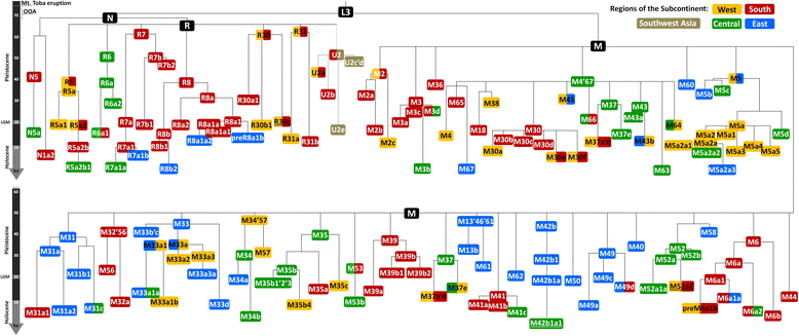
The genetic history of the Indian subcontinent is the result of multi-stage migrations, dominated by men from Central Asia during the Bronze Age, which left a strong mark on the male genome. In contrast, female lineages show continuity from the earliest human settlement in the region. The study challenges simplistic models of "Aryan invasion" and shows that India's genetic structure was shaped by complex and multilayered demographic processes.The study, "A genetic chronology for the Indian Subcontinent points to heavily sex-biased dispersals" (Silva et al., 2017), analyzes the settlement history of the Indian subcontinent based on genetic data, pointing to distinctly different migration patterns of men and women. Main results: The origin of mtDNA and prehistoric settlement: maternally inherited mitochondrial DNA (mtDNA) lines document the very early settlement of modern humans in India, some 55-65,000 years ago. A number of autochthonous mtDNA haplogroups (e.g., M and R) have been identified, which bear witness to the population's long isolation. An increase in the female population was observed around 40 ka and 12-9 ka, which coincides with archaeological data (e.g., the emergence of microliths and the Neolithic). Male lineages (Y-DNA) and migrations: Y-chromosome lines reflect much younger migrations - mainly from Central and Western Asia in the last 10,000 years. There was a particularly intense influx of males during the Bronze Age (~3.5-4 ka), consistent with the pattern of Indo-European expansion from the Pontic-Caspian steppe region. Strong sexual asymmetry: Gene spread patterns are strongly sexually divergent: most mtDNA is indigenous (70-90%), while Y-DNA is largely Western-derived (50-90%). This pattern is consistent with the patrilocal and patriarchal pastoral society attributed to early Indo-Europeans. Complexity of migration and cultural influences: India was reached by numerous migratory waves from the West (Middle East, Iran, Anatolia, Caucasus) in different eras - from the last glaciation (~20 ka), through the Neolithic (~9-5 ka), to the Bronze Age (~4-3 ka). The mtDNA lines indicate that women's migrations were much rarer and included mainly earlier periods (e.g., the Neolithic), while the Y-DNA lines confirm a massive influx of men with the R1a-Z93 haplogroup during the Bronze Age.
Comments
Be the first to comment!