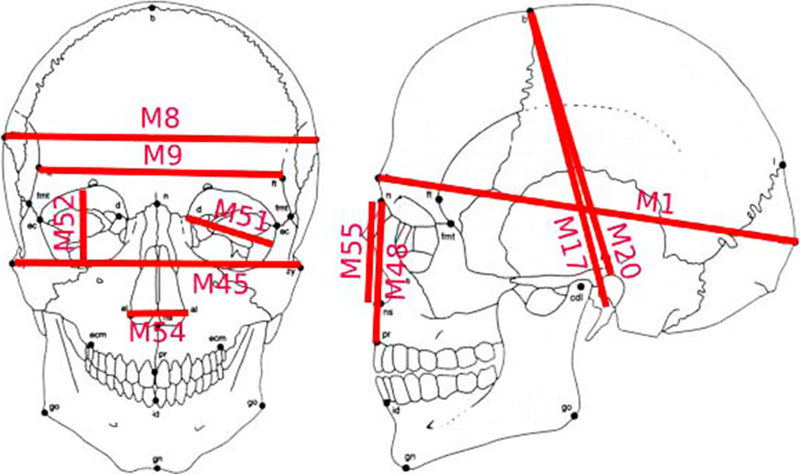
This article attempts to provide a comprehensive and representative picture of the development of European cranial morphology from the Upper Paleolithic to the Late Eneolithic/Bronze Age turn, a work that was last carried out more than three decades ago. One of the main priorities was to bring the subject to the layperson, which naturally required presenting the results as vividly as possible and placing them in the context of popular anthropological terminology. Another important goal was to compare the development of the European cranial form with the results of recent paleogenetic studies, which have not yet been carried out on such a large scale. The data presented here show that for at least 25,000 years, the average cranial features of European populations remained relatively stable, dominated by a robust, broad-faced morphotype, and it was only after the arrival of the Anatolian farmers with their slender, narrow-faced morphology around 6,000 BCE that variability in this regard generally increased. The striking physical, genetic and geographic contrast between the two groups lasted about 3,000 years and was finally broken by the Yamnaya invasion from the eastern European steppes, which completely changed the genetic map of the continent. The interaction between genetically alien populations gave rise to two new and unique morphological types, associated with the Shoemaker pottery culture and the Bell Cup culture. In contrast, the data presented here do not provide convincing evidence for morphological changes associated with the Mesolithic to Neolithic transition.
Comments
Be the first to comment!