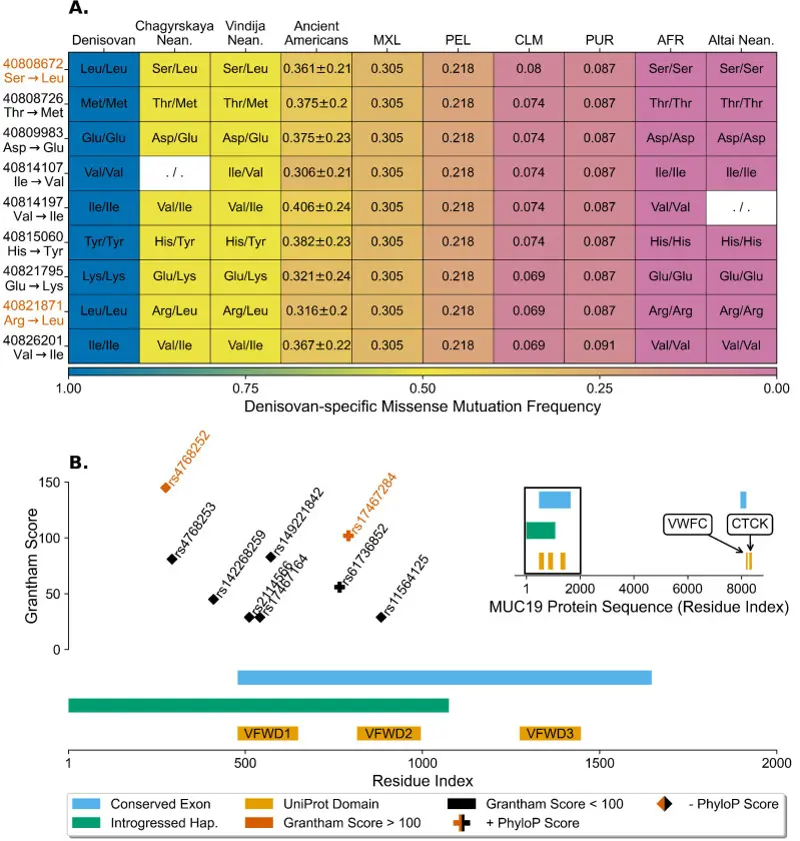
The gene MUC19, for which modern humans carry a Denisovan-like haplotype, was studied. MUC19 is a mucin, a glycoprotein that forms gels with various biological functions. Diagnostic variants of the Denisovan-like MUC19 haplotype have been discovered with high frequency in mixed Latin American individuals among global populations and with the highest frequency in 23 ancient Native American individuals, all preceding mixed populations with Europeans and Africans. We find that the Denisovan-like MUC19 haplotype carries a higher copy number of 30 base pairs of a variable number of tandem repeats, and the copy number of this repeat is unusually high in American populations and subject to positive selection. This study provides the first example of positive selection acting on archaic alleles at coding sites and VNTRs. Finally, we discovered that some Neanderthals carry the MUC19 haplotype similar to the Denisovan haplotype, and that it was most likely introduced into the human population through Neanderthal introgression rather than Denisovan introgression.
Comments
Be the first to comment!