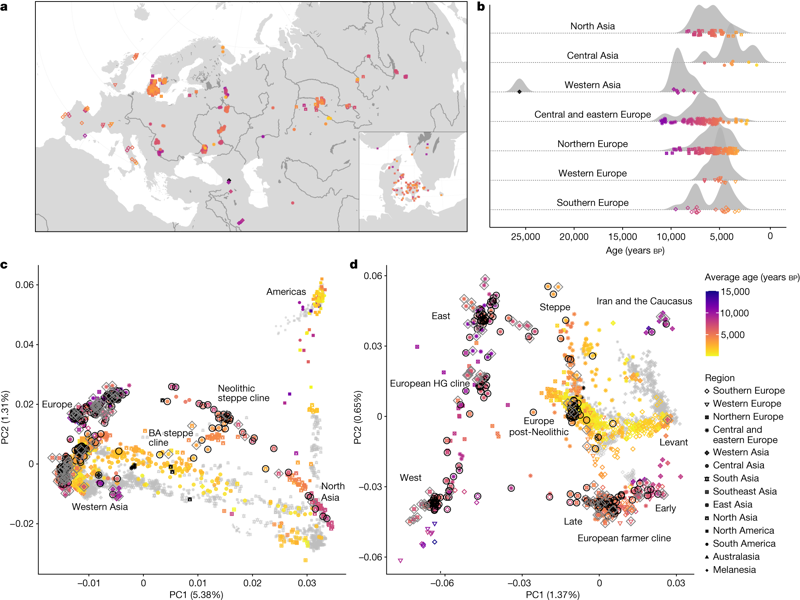
The study, "Population genomics of post-glacial western Eurasia" (Nature, 2024), presents an analysis of more than 1,600 genomes of ancient humans (including 317 new sequences) from the Mesolithic and Neolithic periods, covering a wide area of Eurasia - from the Atlantic to Lake Baikal. Its main findings include: The Great Genetic Divide (Great Divide): from the Black Sea to the Baltic, there was a permanent genetic boundary between the hunter-gatherers of Western Europe (WHG) and Eastern Europe (EHG). These differences persisted for thousands of years and indicate independent trajectories of population development after the last glaciation. Differential effects of neolithization: To the west of the "Great Divide," the Neolithic brought massive displacement and almost complete genetic replacement of hunting populations by farmers from Anatolia. In the east (the Baltic, Ukraine, Russia), hunter-gatherer societies lasted much longer - until the steppe expansion about 5,000 years ago - with no clear Anatolian admixture. The origin and expansion of steppe peoples: The study identifies hunter-gatherers from the middle Don as the main ancestral source for the Yamna (Yamnaya) culture, alongside the Caucasian component (CHG). Yamnaya populations moved westward, creating a new genetic component that quickly dominated Europe-especially through the Corded Ceramic Culture (CWC), previously mixed with the Globular Amphora Culture (GAC). Two-phase population exchange in Scandinavia: first Anatolian farmers replaced local hunters, and then were themselves almost completely displaced by steppe peoples within ~1000 years. Eastern Eurasia: hunter-gatherer populations lasted much longer and exhibited a mosaic genetic structure, with an admixture of ancestors from Siberia, Northeast Asia and the western steppe. Migrations associated with the Afanasyev and later Sintashta/Andronovo cultures introduced a steppe component, but only after 3,700 years ago. Decline in kinship and increase in population size: since the Neolithic, there has been a decline in in-group kinship ties, indicating an increase in effective population size. Disintegration of the genetic boundary: the east-west boundary only disintegrated as a result of the expansion of steppe herders with the Yamnaya culture. This was facilitated by new technologies (carts, horses, chariots) and climatic adaptations. The study sheds new light on the complex processes of migration and population mixing in the Holocene, revealing regions previously poorly understood, especially in Eastern Europe and western Siberia.
Comments
Be the first to comment!